Why Every Dentist Needs Professional Liability Insurance

As a dentist, you work to better the oral health of all people, especially those who walk through your doors. However, dentists are not exempt from the risks associated with medical work. You could inadvertently injure or harm a patient during a procedure. Though you trust the quality of your work—and you should—the frustrating reality is that everyone will make a mistake at some point. Here is why every dentist needs professional liability insurance.

What Is Professional Liability Insurance?

Professional liability insurance is a kind of insurance coverage related to the risks involved in a person’s line of work. Medical professionals are at a much higher risk of legal claims against them than individuals in other careers. Though many dentists don’t perform the same kinds of invasive procedures as other medical professionals, they still put their patients at risk with their tools and methods. Professional liability insurance covers dentists from alleged malpractice, negligence, and other injury-causing errors.

Who Do Dentists Need It?

Like all other medical professionals, dentists need a safeguarded career from the claims of their clients. Dental procedures involve strong and sharp tools moving in vulnerable places—not to mention that the mouth is near other critical organs such as the brain and eyes. Debilitating complications rarely occur from dental work, but the fact is that it’s a reality from which you should protect yourself.

Where Can Dentists Find It?

Research is the first step in finding insurance as a dentist. Reach out to friends and trusted colleagues for recommendations and details regarding their insurance. Professional liability policies vary in their size and scope, but our medical malpractice insurance for dentists is the perfect option for any practicing dentist in the US.

Once you know why every dentist needs professional liability insurance, you can take the proper steps to protect your career. The last thing you need is to deal with a legally and financially ruinous problem as you advance your career. Contact our team at Baxter & Associates to get the coverage you need and the peace of mind you deserve.

Types of Medical Malpractice Insurance Companies

Whether doctors commit medical malpractice or not, patients file claims against their physicians due to damages sustained during treatment. Because of the persistent threat of a malpractice or negligence claim, medical malpractice insurance companies exist to protect physicians from career-damaging financial ruin. This form of professional liability insurance supports medical professionals when they need it most. If you are new to the insurance field, here are the types of medical malpractice insurance companies you should know.

What Are Medical Malpractice Insurance Companies?

There are many kinds of insurance companies, but what exactly is a medical malpractice insurance company? Well, this sort of insurance company provides their insured medical professionals with top-notch malpractice insurance. Professionals use this insurance when claims of medical malpractice or negligence land on their doorstep. With their insurer’s help, they can weather the financial storm that these claims often become.

Malpractice claims and lawsuits are expensive. From legal fees to settlements to damages, insurance companies aid their clients in times of financial distress. Though the specific policies limit the extent of these financial obligations, the essence of insurance companies lies in their ability to protect their policyholders’ financial assets. Insureds pay the insurance company regular fees every month to keep their policy. However, an insurance company’s value lies in its ability to provide the funds they commit to their clients in times of need.

Medical malpractice insurance companies typically offer two kinds of insurance for individual professionals: claims-made and occurrence policies. These policies differ in handling the timing of claims and incidents, but they both offer measured risk reduction for medical professionals. Medical malpractice insurance companies primarily protect people like doctors, nurse practitioners, and certified registered nurse anesthetists with policies like our malpractice insurance for healthcare professionals at Baxter & Associates.

The Main Types of Malpractice Insurance Companies

Now that you have a handle on the scale of medical malpractice insurance companies, it’s time to look at their structure. When learning about insurers, it is essential to know about their organization, ownership, legal responsibilities, and financial stability. The following are the key types of malpractice insurance companies that you must know.

Mutual Insurance Companies

Mutual insurance companies vary from commercial insurance companies in their ownership. The policyholders in a mutual medical malpractice insurance company are also the owners of the company. This somewhat democratic form of insurance allows policyholders to determine who manages their funds and policies. Due to its structural differences, mutual insurance companies appeal to those who can afford a place in the group. When researching medical malpractice insurance companies, you should determine who owns the company and how the management operates.

The profits from their financial portfolio directly impact policyholders in the form of dividends or premium reductions. In the field of medicine, a mutual insurance company may look like a group of similarly specialized doctors sharing their funds and creating better coverage and cost solutions for their shared risks.

Captive Insurance Companies

A captive insurance company is a form of self-insurance that addresses the risks of its owners. These owners are usually a group of parent or related companies that need a specific form of insurance. Captive insurance companies exist because insurance policies don’t always cover the exact risks many businesses encounter. When these companies form a captive insurance entity, they have the leeway to tailor policies to their own needs and lower their insurance costs. The process involves significant personnel, tax, and overheard considerations, but the benefits far outweigh the cost. Depending on the nature of a medical facility, they may decide to band together with others in their respective field to cover gaps in their insurance.

Trust Insurance Companies

As the name implies, trust insurance companies operate with the financial backing of a trust. Like an unincorporated trust, a trust insurance company must have trustees who manage the use of funds on behalf of the beneficiaries. Physician-owned insurance companies can take the form of a trust when they want particular financial securities. These medical malpractice trust insurance companies often have a select group of doctors and insurance agents as their trustees. With their specialized knowledge and leadership, trust insurance policies have better direction than if non-physicians ran it.

Risk Retention Insurance Companies

Risk retention groups offer forms of liability insurance to both commercial and government entities. Like captive insurance companies, risk retention groups serve a group of like-minded businesses who pool their funds to manage their similar risks. Risk retention groups are different from these other insurance companies in that state and federal law regulate them. This legal binding changes how they operate, how the government monitors them, and where they can do business. Medical malpractice insurance is one of the most popular policy types that these groups provide.

These are the types of medical malpractice insurance companies out there, so find the right coverage today. If you need anything, from dentist to surgeon to chiropractor malpractice insurance, reach out to our team at Baxter & Associates today.

Types of Medical Malpractice Insurance Companies

Medical Malpractice Terms That All Doctors Should Know

If you studied medicine, you likely spent very little time diving into the nitty-gritty of law. But medical malpractice claims and legalese can creep into your professional life when you least expect it. Here are a few of the medical malpractice terms that all doctors should know.

Informed Consent

Informed consent refers to the explicit acknowledgment and approval of medical treatments by the patient. This consent is critical for medical professionals to begin treatments and perform operations. Informed consent requires that a patient be fully aware of all risks from their treatment. You must obtain a patient signature and have it on record in case a claim arises later. If you have a physician or physician assistant medical malpractice insurance policy, you will need these documents for financial coverage.

Standard of Care

Standard of care refers to the quality of care expected from a credentialed professional. As a doctor, you should perform your duties to the highest degree possible, treating patients with the utmost respect, timeliness, and attention. Without these key elements, a patient could claim negligence or malpractice. Always give each patient the same high quality of care, and you will reduce the probability of negligence claims.

Malpractice Insurance

Medical malpractice refers to improper actions by a medical professional. Medical malpractice insurance comprises the policies that cover such professionals from their actions, or lack thereof. Malpractice insurance comes in all forms depending on your insurer, but you should know the basic differences between claims-made, occurrence, nose, and tail policies. Each policy covers certain incidents and claims that the others do not. If you don’t have malpractice insurance to protect you, reach out to our team at Baxter & Associates today for immediate assistance.

Equip yourself with the medical malpractice terms that all doctors should know. If you treat every patient and procedure with high regard, you should seldom have to worry about claims of negligence or malpractice.

How Nurse Practitioners Can Practice On Their Own

Students attend medical school to help people and practice the intricate art of medicine. Nurse practitioners train for years and have their practice regulated by the state. From restricted to reduced to full practice, NPs have an array of work options depending on where they work. Here are how nurse practitioners can practice on their own.

Obtain the Right Certifications

The first step in practicing as an NP is proving your qualifications. By now you’ve finished the right programs and joined the correct associations, but you must verify all this before practicing with patients. Collect all your certificates, degrees, and licensures and present them to the state where you want to work. Practicing on your own requires direct state approval, so do your due diligence to establish your scope of practice.

Find the Best Location

Apart from the standard queries all business startups must consider, nurse practitioners beginning their own practice or looking to join an established practice must find the right location. Since NP regulations vary from state to state, research where your degree has the most value and allows you the most freedom. Though nurse practitioners don’t hold a classical MD or DO, they are highly trained medical professionals capable of independent practice. So, look for a state where you can work independently and find a city or town that interests you.

Protect Your Career

When you step out on your own, you must protect your career. One of the primary ways you can do this is to find a medical malpractice insurance policy. These policies will drastically change your ability to recover in the face of patient claims, financially and legally. In fact, our nurse practitioner liability insurance at Baxter & Associates is one of the most comprehensive options out there.

Understanding how nurse practitioners can practice on their own equips newly graduated NPs to find their way into the workforce. If you need medical malpractice insurance for your budding career, reach out to our team at Baxter & Associates to find the right solution for you.

What State Has Damage Caps on Medical Malpractice Insurance

Finding medical malpractice insurance is one thing, but using it is quite another. You must coordinate with your insurance agency, but policy details and state regulations limit their ability to help you. Read ahead to learn what state has damage caps on medical malpractice insurance.

What Are Damage Caps?

Damage caps relate to all kinds of personal injury lawsuits. They are state-specific limits on non-economic damages awarded in legal cases. Non-economic damages, as the name implies, are indemnities stemming from a plaintiff’s injury, pain, and suffering, as opposed to financial losses they sustain. Damage caps exist since non-economic damages relate to subjective calculations in court. If the case gets to a jury, lawyers can influence this group of peers to consider higher payouts. Damage caps prevent personal injury cases from overcompensating plaintiffs while allowing for any amount up to the maximum.

How Do They Affect Medical Professionals?

Damage caps are common in medical malpractice suits since medical circumstances often lead to severe consequences. Though the penal system may allow for the maximum amount, the cap sets a limit to how much medical professionals must pay. Damage caps essentially protect the defendant from unduly large recompense. This is good news for medical professionals from MDs to NPs.

Where Are They in Effect?

Every state has its own purview to decide their damage caps. You will need to visit your state government’s website or contact local officials for the most accurate and up-to-date information. However, nearly half of all the states in the US have established damage caps. Research your situation and understand whether your state sets limits. If you cannot find the information you need, reach out to local contacts or your insurance agency.

Know what state has damage caps on medical malpractice insurance so you can adequately prepare your assets and adjust your insurance policy. For example, if you need more protection on a nurse practitioner liability insurance policy, reach out to our insurance professionals at Baxter & Associates for more information.

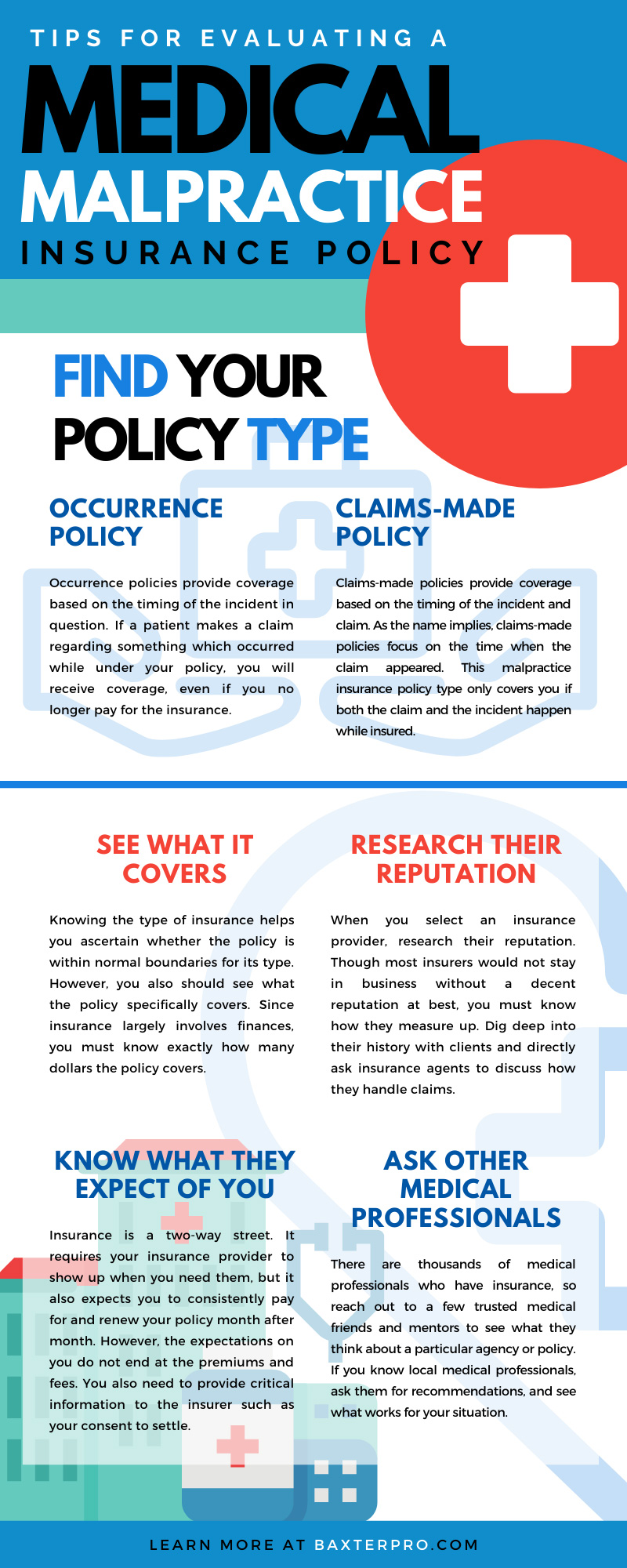
Tips for Evaluating a Medical Malpractice Insurance Policy

No matter what realm of medicine you work in, you need professional liability protection. For medical professionals, this typically means a medical malpractice insurance policy. Here are a few tips for evaluating a medical malpractice insurance policy.

Understand What Malpractice Insurance Is

The first step in policy evaluation is research. You must know what medical malpractice insurance is to adequately assess it. Malpractice insurance is a form of professional liability insurance tailormade for medical professionals. These policies cover doctors, nurse practitioners, and certified registered nurse anesthetists alike in legal matters. The nature of medicine opens practicing professionals to claims made by patients about inadequate, incompetent, or malicious care. If you receive a claim from a patient, your insurance will help cover the costs as delineated in your specific policy.

Find Your Policy Type

When you evaluate insurance, you must know what kind of policy you want or have. Medical malpractice insurance typically comes in two formats: occurrence policies and claims-made policies, each with its specific parameters.

Occurrence Policy

Occurrence policies provide coverage based on the timing of the incident in question. If a patient makes a claim regarding something which occurred while under your policy, you will receive coverage, even if you no longer pay for the insurance. Since the incident happened beforehand while paying for the insurance, you will reap the benefits of the policy.

Claims-made Policy

Claims-made policies provide coverage based on the timing of the incident and claim. As the name implies, claims-made policies focus on the time when the claim appeared. This malpractice insurance policy type only covers you if both the claim and the incident happen while insured. Unlike occurrence policies, you lose any retroactive coverage once you end the policy.

See What It Covers

Knowing the type of insurance helps you ascertain whether the policy is within normal boundaries for its type. However, you also should see what the policy specifically covers. Since insurance largely involves finances, you must know exactly how many dollars the policy covers. As with all insurances, medical malpractice insurance coverages vary by location, professional role, policy type, and provider. The best course of action is to contact insurance providers and ask them for details. If you have any questions about what your coverages should include, reach out to our team of insurance professionals at Baxter & Associates.

When you call an insurance agent, you will want to ask about specific coverage items such as the defense costs. During any malpractice case, you will likely have extensive legal fees, attorney fees, and expert witness fees, not to mention court costs. Defense coverage will list exactly what they cover and how much they back you financially. Also, ask them about their liability limits. Though they likely have tiers depending on your premiums, it is important to know their baseline limits. This way, you can compare offers to find the best rates for the most coverage.

Know What They Expect of You

Insurance is a two-way street. It requires your insurance provider to show up when you need them, but it also expects you to consistently pay for and renew your policy month after month. Like all services you pay for, you should evaluate how the insurance works for you professionally and determine if there are better financial solutions available. However, the expectations on you do not end at the premiums and fees.

You also need to provide critical information to the insurer such as your consent to settle. This agreement is critical to understand as a medical professional. In the event a patient makes a claim against you, the option exists to consent to settle the case with a financial or equivalent payout. Your insurance provider covers you monetarily, so they may want to determine how much to pay and how they conduct the transactions. A consent to settle agreement either establishes your consent as necessary to settle or allows the insurer to settle on your behalf. Depending on your reputation and circumstances, you may or may not want this as part of the deal so be sure to know what insurance agencies expect of you.

Research Their Reputation

When you select an insurance provider, research their reputation. Though most insurers would not stay in business without a decent reputation at best, you must know how they measure up. Dig deep into their history with clients and directly ask insurance agents to discuss how they handle claims. When you know more about their track record, you can either move on or rest assured you chose well. As you research their reputation and company information, also check for any discounts or promotions, they could help you save money in the long haul.

Ask Other Medical Professionals

There are thousands of medical professionals who have insurance, so reach out to a few trusted medical friends and mentors to see what they think about a particular agency or policy. If you know local medical professionals, ask them for recommendations, and see what works for your situation. For example, if you are a nurse practitioner moving to a new state and switching policies, research a malpractice insurance plan for nurse practitioners like ours at Baxter & Associates and ask medical workers in your new region about who they use.

Make a Decision

After all the evaluation and consideration, you must decide on a policy. This can be hard to do when faced with similar options at similar rates, but go with the agency you trust most. Whoever you believe you can rely on in financial and legal distress is who you should select. If you find yourself wanting different coverage in the future, you can either look to increase your premiums or locate better options elsewhere.

Use these tips for evaluating a medical malpractice insurance policy and find the best solution for your needs. Our insurance team at Baxter & Associates can help you find the right policy for your specialization and practice today!


Tips for Evaluating a Medical Malpractice Insurance Policy

General vs Professional Liability Insurance

All insurance serves to cover clients for various financial disputes they could face in their personal lives or in the workplace. Whether you are in a car accident or receive a malpractice claim, insurance helps you avoid financial ruin. When looking for insurance, you should know how to differentiate between policy types. Here is the difference between general vs professional liability insurance.

What Is General Liability Insurance?

As the name implies, general liability insurance is a broader form of insurance compared to the professional type. Typically, general liability insurance covers a business or corporation from physical risk and property damage liabilities. When bodily injuries occur on your premises or you cause damage to another person’s property, people can file a claim against you. Depending on your industry, these policies can cover you for injuries as well as slander and copyright infringement.

What Is Professional Liability Insurance?

Professional liability insurance hits closer to the personal side of insurance rather than the corporate. This insurance type covers risks such as negligence and malpractice in delivering your services. Claims in this realm typically revolve around a physical injury or financial loss. For example, medical malpractice insurance for dentists is a professional dental liability insurance policy that covers malpractice and negligence claims.

How Do I Choose?

One company or person may choose to have both general and professional liability insurances. Since they cover different scenarios, it is up to you to choose the insurance you want. If you choose general liability insurance, you are protecting your business from broader issues in business operations. However, if you choose professional liability insurance, you are protecting yourself from errors and omissions in your own services. It may be wise to have your own professional policy while leaving the general one to your employer. If you are a business or practice owner, try taking policies out for both in order to cover all your bases.

Know the difference between general vs professional liability insurance so you can adequately protect your business and personal assets. If you have any questions about these insurance types or would like to find the right policy for your situation, reach out to our insurance professionals at Baxter & Associates today.

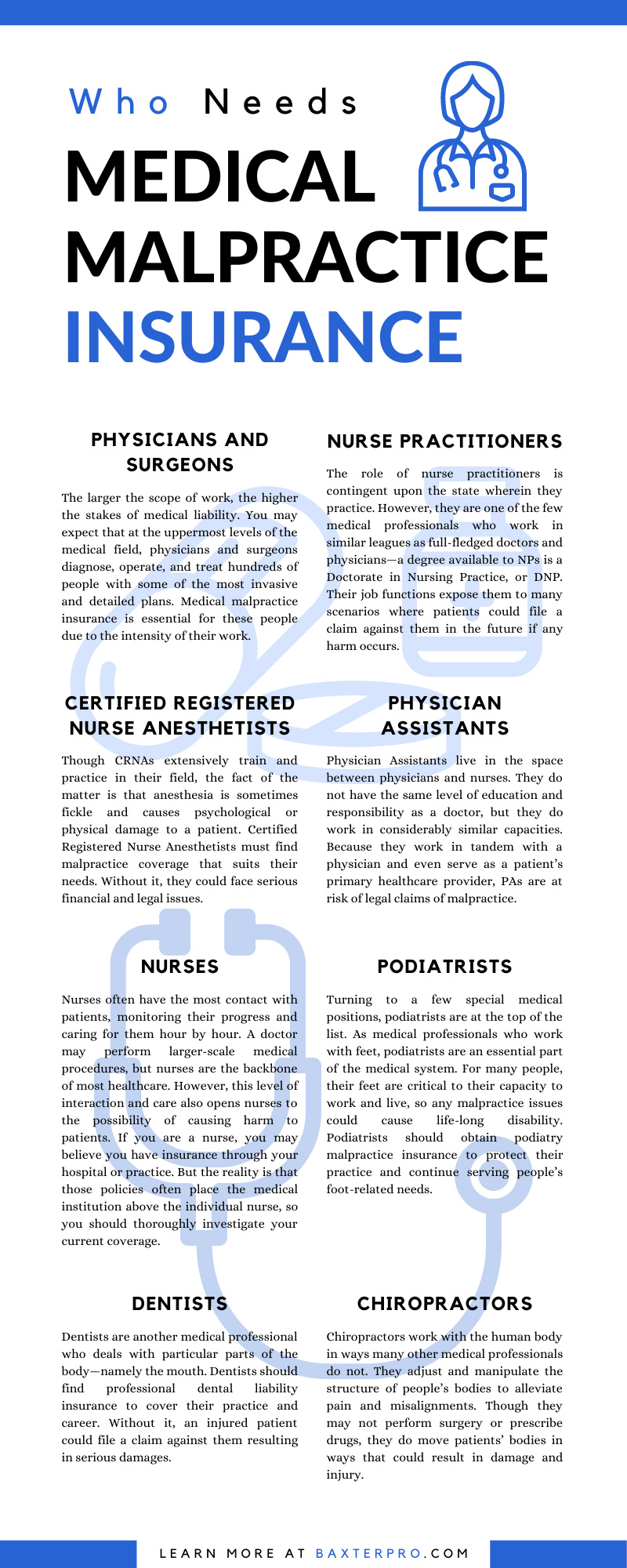
Who Needs Medical Malpractice Insurance

In medicine, there is always the possibility of a mistake. Your years of training and focus pay off with most of your patients. However, there is the off chance that your medical advice, treatment, or procedure ends up harming a patient in unforeseen ways. Under these circumstances, it is important for medical professionals of all types to have the appropriate insurance coverage. Without it, you could be in serious financial and professional trouble. To start your journey into the insurance world, here is who needs medical malpractice insurance and why it is so important.

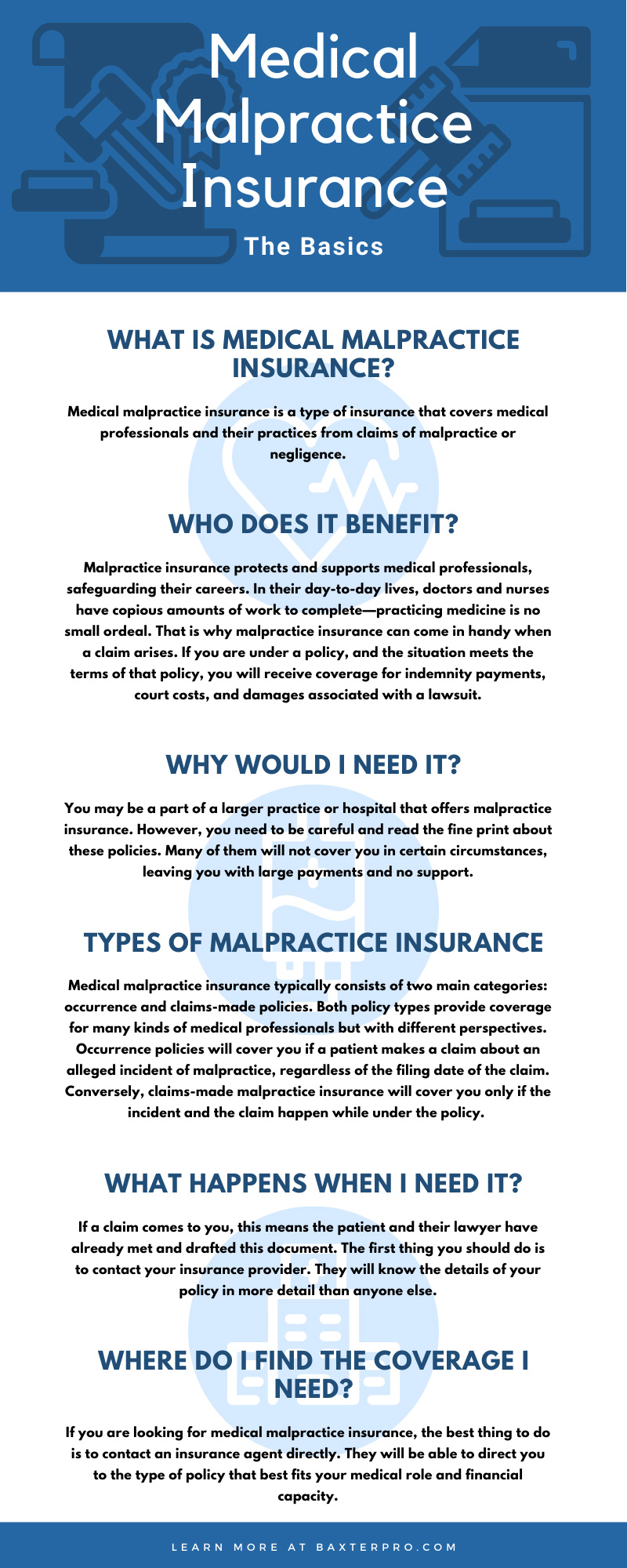
A Brief Description of Medical Malpractice Insurance

What is medical malpractice insurance? This particular form of insurance is no stranger to the majority of physicians and medical professionals practicing in the United States. However, if you are entering the field or looking for your first job in medicine, you may not know about these policies. At its core, medical malpractice insurance is a form of professional liability malpractice insurance for medical professionals. This insurance provides certain coverages—each provider dictates the specific amounts and terms—for medical professionals if they come under fire.

Who Needs Medical Malpractice Insurance?

The world of medicine is as deep as it is wide; there are dozens and dozens of specializations, trainings, and roles. But the reality is that almost anyone who plays a part in the diagnosis, treatment, operation, and care of a patient is responsible and liable to some degree. So, the short answer is everyone! Even if it is to just cover your bases professionally, obtaining medical malpractice insurance is critical to the longevity of each medical professional’s career. If you or someone you know is looking for medical malpractice insurance, reach out to our team here at Baxter & Associates. Here is a comprehensive list of the people who must have this type of insurance.

Physicians and Surgeons

The larger the scope of work, the higher the stakes of medical liability. You may expect that at the uppermost levels of the medical field, physicians and surgeons diagnose, operate, and treat hundreds of people with some of the most invasive and detailed plans. Though MDs and DOs are essential to the medical process, their job descriptions leave them open to serious risks. Medical malpractice insurance is essential for these people due to the intensity of their work. Physicians, doctors, and surgeons all need adequate coverage to secure a long and prosperous medical career.

Nurse Practitioners

The role of nurse practitioners is contingent upon the state wherein they practice. However, they are one of the few medical professionals who work in similar leagues as full-fledged doctors and physicians—a degree available to NPs is a Doctorate in Nursing Practice, or DNP. Nurse practitioners, like all medical professionals of their grade, work with patients every step of the way. Their job functions expose them to many scenarios where patients could file a claim against them in the future if any harm occurs. So, it is best for NPs and ARNPs to obtain the proper medical malpractice insurance ahead of time.

Certified Registered Nurse Anesthetists

CRNAs or Certified Registered Nurse Anesthetists are integral to the success of surgical operations. They are responsible for selecting anesthetics, administering them, monitoring patients, and awakening them from anesthesia-induced sleep. Anesthesia is complex and CRNAs must tailor each vial and dosage to their patient’s needs. Going under can be scary for patients and anesthesia does not always work in its intended capacity. Though CRNAs extensively train and practice in their field, the fact of the matter is that anesthesia is sometimes fickle and causes psychological or physical damage to a patient. Certified Registered Nurse Anesthetists must find malpractice coverage that suits their needs. Without it, they could face serious financial and legal issues.

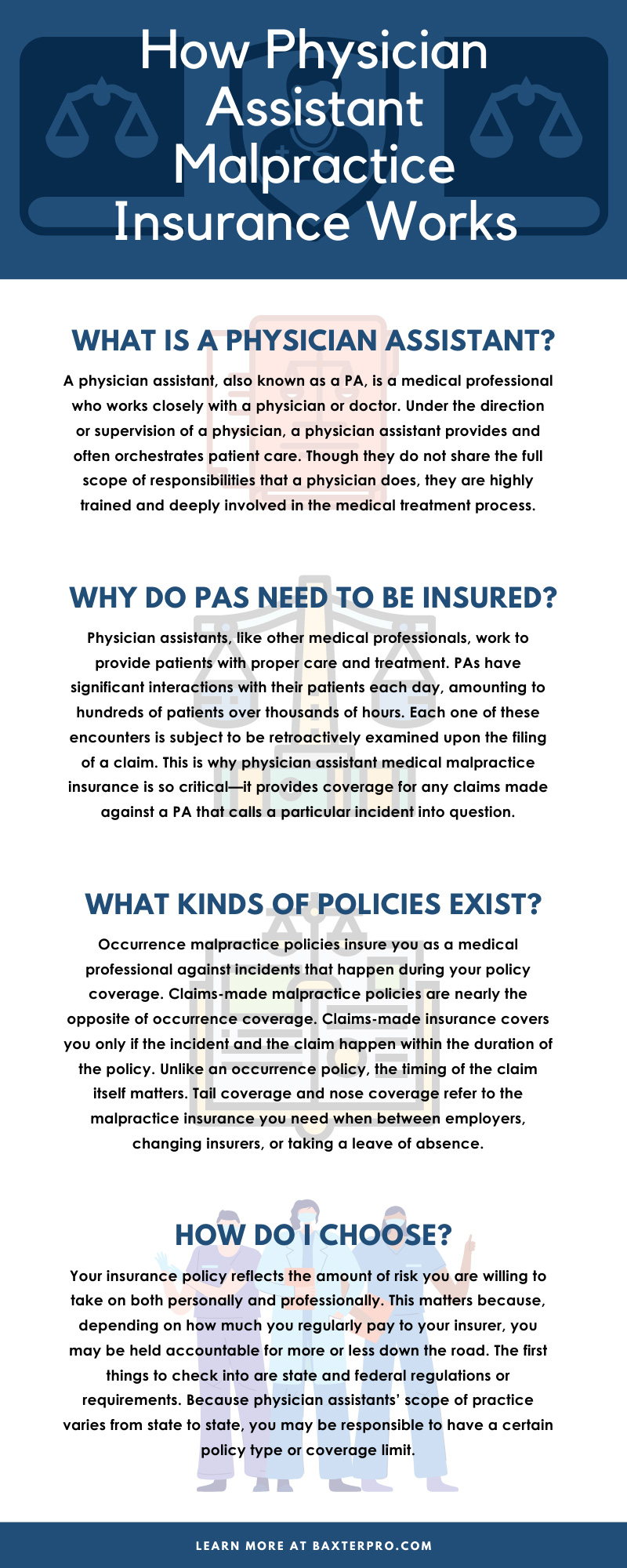
Physician Assistants

Physician Assistants live in the space between physicians and nurses. They do not have the same level of education and responsibility as a doctor, but they do work in considerably similar capacities. Because they work in tandem with a physician and even serve as a patient’s primary healthcare provider, PAs are at risk of legal claims of malpractice. With the right physician assistant malpractice insurance, PAs can continue their work with peace of mind.

Podiatrists

Turning to a few special medical positions, podiatrists are at the top of the list. As medical professionals who work with feet, podiatrists are an essential part of the medical system. For many people, their feet are critical to their capacity to work and live, so any malpractice issues could cause life-long disability. Podiatrists should obtain podiatry malpractice insurance to protect their practice and continue serving people’s foot-related needs.

Dentists

Dentists are another medical professional who deals with particular parts of the body—namely the mouth. Dentists should find professional dental liability insurance to cover their practice and career. Without it, an injured patient could file a claim against them resulting in serious damages.

Chiropractors

Chiropractors work with the human body in ways many other medical professionals do not. They adjust and manipulate the structure of people’s bodies to alleviate pain and misalignments. Though they may not perform surgery or prescribe drugs, they do move patients’ bodies in ways that could result in damage and injury. Chiropractor professional liability insurance is the way to go for chiropractors who want to head off any legal claims.

Knowing who needs medical malpractice insurance equips you to find the right solution for your professional goals. With focused research, budgeting, and planning, you can secure insurance that will cover you for your entire career and ensure a bright future for your vocational journey. If you have questions about any of these insurance types or want more information about one of our tailor-made policies, reach out to us at Baxter & Associates today.

Who Needs Medical Malpractice Insurance

The Importance of Malpractice Insurance for Chiropractors

The world of medicine is vast, with thousands of people in hundreds of specializations, including chiropractors. Here is what you should know about the importance of malpractice insurance for chiropractors.

No One Is Risk-Free

You may be the most passionate chiropractor in the world and work with the most practiced precision. But there may come a time when a client makes a claim against you, and you have to handle a time-consuming and financially draining problem. Passion and perfection are not sufficient protections against the will of an allegedly harmed patient—no one is risk-free. Chiropractors need to obtain medical malpractice insurance specific to their branch of medicine.

Safeguard Your Career

Malpractice insurance for chiropractors is critical for long-term stability. Your medical career not only depends on the quality of your work and the credibility of your experience, but also on your financial liquidity over time. If you do not have enough assets to continue practicing your work, you are essentially out of business. Claims against chiropractors and other medical professionals can end up in court with hefty settlements. Whether you cover for lawyer fees, court fees, or settlement payments, you will shell out a significant amount of money—so much so that many people cannot bounce back from such losses. Safeguard your career today with insurance that fits your needs and budget.

Protect Yourself Now

There is no sense in waiting for a claim to come across your desk. It is best to acquire insurance now for anything that could happen tomorrow. Patients and their lawyers typically take time to write and file a claim against you. Research your options for insurance coverage and reach out to a trained insurance professional today like those on our staff here at Baxter & Associates.

We cannot overstate the importance of malpractice insurance for chiropractors. If you have any questions about chiropractic malpractice insurance or would like to speak to an agent today, contact us at Baxter & Associates.

The History of Medical Malpractice Law

The history of medical malpractice law in the U.S. is long and complex, but some shining moments truly shifted the tide. Medical professionals must adhere to ethics codes.

Here is more on the foundation of modern medical malpractice law.

The Beginning

The very first medical malpractice case in the United States took place in 1794. The plaintiff’s wife died at the hands of a doctor who claimed he performed a proper operation. The husband won the case, marking the beginning of medical malpractice law in the U.S. In the centuries since then, medical malpractice cases have increased, as have the number of lawyers working in this field of law.

Into the Courts

The state is usually the entity with authority over medical malpractice law as opposed to the federal government, so these cases are filed in a state trial court. Because of the division between all states, each jurisdiction has a slightly different way of handling various malpractice issues based on the history of local rulings. Though there is a foundational common law, the state legislature provides minor modifications.

Medical Malpractice Today

Standardization has made medical malpractice law today much different than how it was in the 1700s. All medical professionals interacting with patients should have protection from these cases. Whether you are a surgeon, pediatrician, or nurse practitioner, liability insurance is critical to safeguarding your career. Though it all began with one case, it is estimated that almost 17,000 medical malpractice cases are filed each year in this country. Malpractice law has even reached public view with celebrity cases like the ones of Michael Jackson, Julie Andrews, and Elvis Presley.

Understanding the history of medical malpractice law shows us how this type of litigation came to impact medical professionals in the United States. If you have any questions about medical malpractice or are looking for malpractice insurance options, contact us at Baxter & Associates today.